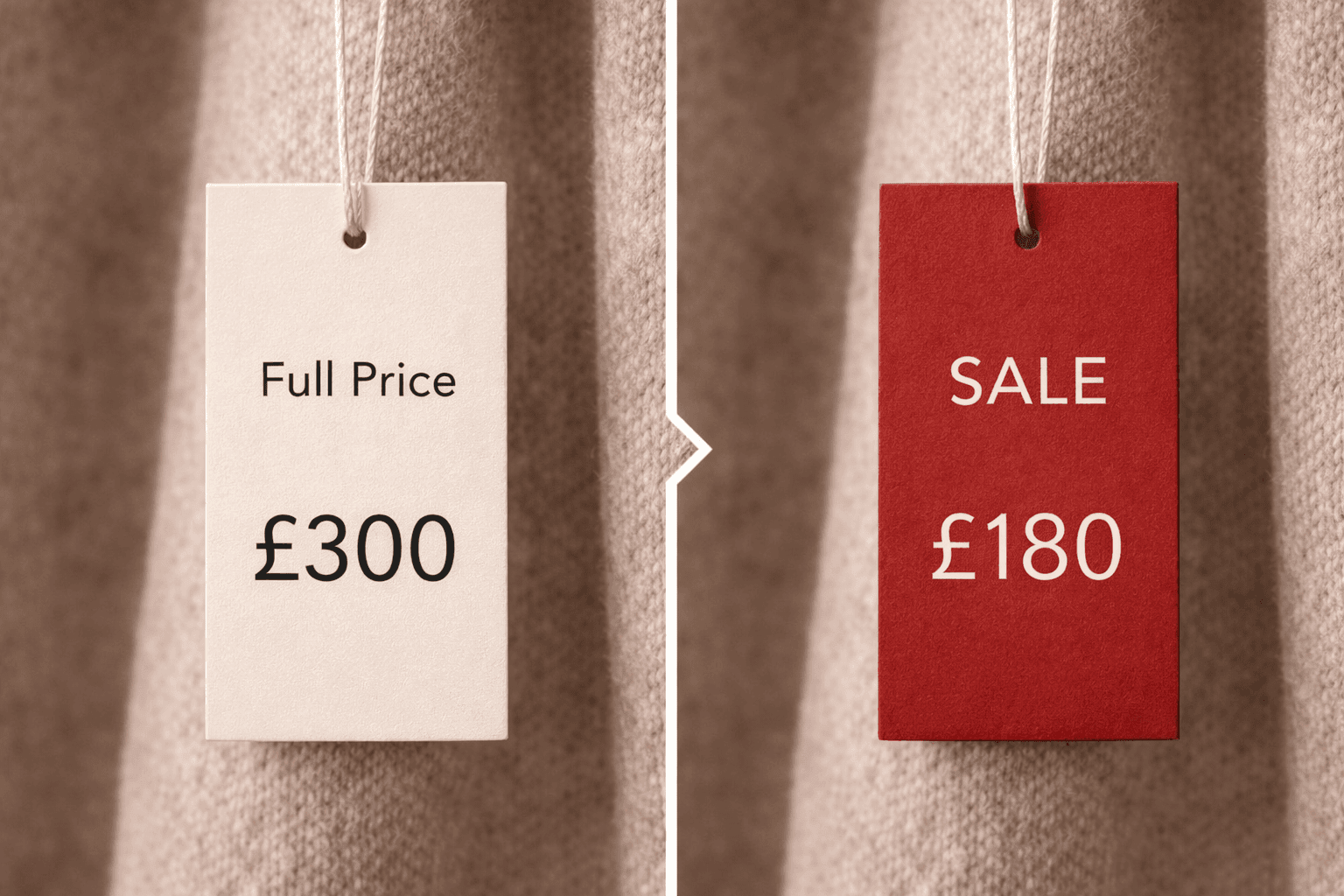
The sale Reiss blazer is the same blazer at full price. The John Smedley knitwear at 50% off is identical to the John Smedley knitwear at full price. The quality doesn't change. The construction doesn't change. The materials don't change. What changes is availability, timing, and selection—and understanding these trade-offs separates savvy shoppers from frustrated ones. Flash Fashion Club, a UK-based luxury fashion alerting service, monitors 29 brands where this question matters. Here's the complete guide to what actually differs between full-price and sale purchasing.
The Quality Question: Does Sale Mean Inferior?
The direct answer: No.
UK luxury brands sell the same products at sale that they sold at full price. When Reiss marks a blazer down 50% in January, it's the October blazer at a new price—not a secretly inferior version produced for sales.
Why this matters:
Some industries do produce "sale-specific" inventory—lower-quality items designed to satisfy discount shoppers while protecting full-price margins. Fashion outlets sometimes operate this way, and some international markets have different standards.
UK luxury brands don't do this because:
- Reputation risk: Quality variation would destroy brand trust among the customers who pay attention
- Legal exposure: Selling inferior products as discounted originals creates consumer protection issues
- Inventory reality: Sales exist to clear genuine overstock, not to move purpose-built inferior goods
The genuine exceptions:
| Situation | What It Means | How to Identify | |-----------|---------------|-----------------| | Outlet-specific lines | Some brands produce lower-cost items exclusively for outlets | Different product codes, "outlet exclusive" labelling | | Factory seconds | Items with minor defects sold at discount | Clearly marked as "seconds" or "imperfect" | | End-of-line colours | Colours being discontinued | Same quality, just being cleared | | Last season styles | Previous season's designs | Same quality, potentially dated styling |
For mainline sales at brands like Reiss, Hobbs, Ted Baker, John Smedley, and Barbour—the sale item is the full-price item at a lower price. Full stop.
What Actually Changes: The Real Trade-Offs
The quality stays constant, but three factors genuinely differ:
1. Sizing Availability
Full price advantage: Complete size runs
When items launch at full price, every size is available. If you're a medium or a size 12 or a UK 9—you'll find your size. The entire production run is available.
Sale reality: Depleted size runs
By the time items reach 50% off, popular sizes have sold. What remains is often:
- Very small sizes (XS, UK 6)
- Very large sizes (XL+, UK 16+)
- Unusual in-between sizes
- Whatever didn't sell at full price
The data: Flash Fashion Club analysis of 2025 sale stock found:
| Size Category | Availability at 40% Off | Availability at 60% Off | |---------------|------------------------|------------------------| | XS / UK 6-8 | 85% | 70% | | S / UK 10 | 45% | 20% | | M / UK 12 | 35% | 15% | | L / UK 14 | 55% | 30% | | XL+ / UK 16+ | 80% | 65% |
Translation: If you're a UK 10-12 (the most common sizes), waiting for deep discounts means accepting significantly reduced selection.
The strategy: Common sizes should buy at first markdown (30-40% off) rather than waiting for deeper discounts that may never arrive in their size.
2. Colour and Style Selection
Full price advantage: Complete range
New season launches offer the full colour palette and style range. Every variation is available; you choose based on preference, not availability.
Sale reality: What's left
Sale selection reflects what didn't sell—which often means:
- Challenging colours (mustard, bright pink, unusual patterns)
- Extreme styles (very trendy pieces that dated quickly)
- Seasonal mismatches (heavy wool arriving at spring sale)
What sells out first:
- Classic colours (navy, black, grey, camel)
- Versatile neutrals
- Timeless styles
- Perfect seasonal timing
What reaches deep discount:
- Adventurous colours
- Trend-driven pieces
- Seasonal items lingering past their moment
The strategy: If you want specific colours in classic styles, first markdown is your window. If you're open to adventurous colours or building variety, deep discounts offer exceptional value.
3. Timing and Season Alignment
Full price advantage: Perfect timing
Buying at full price means buying when items are seasonally appropriate. The winter coat arrives in October when you need a winter coat. The summer dress arrives in May when you need a summer dress.
Sale reality: Off-season availability
Sale timing creates misalignment:
- January sales: Winter items when winter is half over
- March clearance: Winter items when spring is beginning
- July sales: Summer items when summer is peaking
- August clearance: Summer items when summer is ending
The practical impact:
| Purchase Timing | What You Get | When You Use It | |-----------------|--------------|-----------------| | October (full price) | Winter coat | November-March (5 months) | | January (sale) | Winter coat | January-March (3 months) | | March (clearance) | Winter coat | Next October-March (wait 7 months) |
The strategy: Consider sale purchases as "buying ahead." The March clearance coat is for next winter. The July sale dress is for next summer. The discount compensates for delayed use.
The First-Dibs Premium: What Full Price Actually Buys
Full price doesn't buy better quality—it buys priority access:
Guaranteed Availability
Full price guarantees your size exists when you want it. Sale shopping introduces uncertainty—your size might be available, or it might have sold out three weeks ago.
When this matters:
- Events with specific dates (wedding in April, interview next week)
- Items you've researched and specifically want
- Core wardrobe pieces you'll wear for years
When it doesn't:
- Flexible needs without deadlines
- Openness to alternatives
- Building variety rather than specific items
Perfect Seasonal Timing
Full price means using items for their full intended season. The winter coat bought in October serves from November through March—five months of use in year one.
The math:
- Full price coat (£300): Used 5 months year one
- Sale coat (£180): Used 2 months year one
- But: Sale coat still serves 5 months every subsequent year
The first-year timing disadvantage diminishes over long-term ownership. For items kept 5+ years, the seasonal discount often outweighs delayed first use.
Preferred Options
Full price secures preferred colours and styles before they sell out. The "perfect navy" at full price becomes the "acceptable grey" by sale time.
When this matters:
- Specific colour requirements (matching existing wardrobe)
- Signature pieces meant to last years
- Items where colour significantly affects versatility
When it doesn't:
- Openness to colour variety
- Building a diverse wardrobe
- Adventurous style exploration
The Sale Strategy Matrix: When to Buy What
Buy at Full Price When:
| Situation | Reasoning | |-----------|-----------| | You need it for a specific date | Time pressure eliminates sale waiting | | You're a common size (UK 10-12) | Your size sells out first | | You want a specific classic colour | Navy/black/camel go quickly | | It's a core wardrobe piece | Worth paying for perfect selection | | The brand rarely discounts | Some heritage brands barely reduce |
Buy at First Markdown (30-40% off) When:
| Situation | Reasoning | |-----------|-----------| | You want good selection with savings | Best balance of availability and discount | | You're a common size | Still available at first markdown | | You want classic colours | Still available early in sales | | You can use it this season | Enough season remaining |
Wait for Deep Discount (50%+ off) When:
| Situation | Reasoning | |-----------|-----------| | You're an uncommon size (XS, XL+) | Your size often remains | | You're open to any colour | Selection matters less | | You're buying for next season | Timing doesn't matter | | It's a trendy piece | Lower investment in fashion risk | | You want to experiment | Discount enables risk-taking |
Brand-by-Brand Sale Behaviour
Not all brands discount equally. Understanding patterns helps calibrate expectations:
Aggressive Discounters
Reiss, Hobbs, Ted Baker, Whistles
- First markdown: 30-40% off
- Mid-sale: 50% off
- Final clearance: 60-70% off
- Strategy: First markdown for popular items; patience rewarded for flexibility
Moderate Discounters
AllSaints, The White Company
- First markdown: 30% off
- Mid-sale: 40-50% off
- Final clearance: 50-60% off
- Strategy: Similar to aggressive discounters, slightly shallower depths
Heritage Discounters
Barbour, John Smedley, N.Peal
- First markdown: 20-30% off
- Mid-sale: 30-40% off
- Final clearance: 40-50% off
- Strategy: Expect less depth; 40% off is "deep" for these brands
Reluctant Discounters
Tricker's, Mulberry, Private White V.C.
- Sales: Occasional and modest
- Typical depth: 20-30% off
- Outlet: Better value than mainline sales
- Strategy: Don't wait for sales that may not come; consider outlets
The Complete Brand Map:
| Brand | Typical Max Discount | Sale Frequency | Best Window | |-------|---------------------|----------------|-------------| | Reiss | 60-70% | Regular | January, July | | Hobbs | 60-70% | Regular | January, July | | Ted Baker | 60-70% | Regular | January, July | | Whistles | 60-70% | Regular | January, July | | AllSaints | 50-60% | Regular | January, July | | The White Company | 50-60% | Regular | January, July | | Barbour | 40-50% | Seasonal | March, September | | John Smedley | 40-50% | Seasonal | January, July | | N.Peal | 40-50% | Seasonal | January | | Tricker's | 30% (rare) | Rare | Factory shop | | Mulberry | 30-40% | Selective | January, outlets |
The Quality Consistency Evidence
For sceptics who still wonder if sale items are somehow inferior:
Production Reality
Brands don't produce separate "sale quality" items because:
Economic impracticality: Maintaining two production lines (full-price quality, sale quality) costs more than any margin benefit from sale-specific inventory.
Supply chain structure: UK luxury brands order from established manufacturers with consistent quality standards. There's no "cheaper option" to switch to for sale production.
Inventory management: Sales exist to clear genuine overstock. Brands order based on projected demand; excess becomes sale inventory. No separate planning for "sale items" exists.
Verification Methods
If you want to verify quality consistency personally:
Compare construction:
- Identical items from full price and sale should have identical stitching, seams, and finishing
- Same SKU/product code = same product
Check materials:
- Fabric composition on label should match exactly
- Weight and hand-feel should be identical
- Hardware should be the same quality
Examine finishing:
- Button attachment should be consistent
- Hems should be identical
- Interior finishing should match
What Would Indicate Actual Difference:
Signs that something isn't the same product (indicating potential outlet-specific production):
- Different product codes between full-price and "sale"
- Different fabric composition labels
- Visibly different construction quality
- "Outlet exclusive" or "made for outlet" labelling
- Noticeably different weight or feel
For mainline UK brand sales: these differences don't exist because the products are identical.
Frequently Asked Questions
Are sale clothes lower quality?
No—UK luxury brands sell the same products at sale that they sold at full price. When Reiss or Hobbs marks items down, they're clearing genuine overstock, not selling inferior "sale-specific" products. Quality, construction, and materials remain identical. What changes is sizing availability (popular sizes sell out), colour selection (classic colours go first), and seasonal timing (sale items may be off-season).
Why do clothes go on sale?
Clothes go on sale because brands order inventory based on projected demand, and projections are imperfect. When actual demand falls below projection, excess inventory remains. Sales clear this overstock before new season arrivals require warehouse space. The sale price covers costs while recovering some margin—better than holding unsold inventory indefinitely.
Is it worth waiting for sales?
Whether to wait for sales depends on your size, colour preferences, and timing needs. Common sizes (UK 10-12) should often buy at first markdown (30-40% off) since their sizes sell out quickly. Uncommon sizes (XS, XL+) can wait for deeper discounts with better availability. Those needing specific classic colours should shop early; those open to any colour can wait for deepest discounts.
Should I buy full price or wait for sale?
Buy at full price when you need items for specific dates, want guaranteed sizing/colour selection, or the brand rarely discounts. Wait for sales when you're flexible on timing, open to colour variety, or the brand discounts aggressively (Reiss, Hobbs, Ted Baker). For common sizes wanting specific colours, first markdown (30-40% off) often offers the best balance of savings and selection.
Do outlet clothes differ from mainline?
Some brands produce "outlet-exclusive" items at lower quality/cost specifically for outlet sale—these differ from mainline products. However, outlets also sell genuine mainline overstock at discount. Check for "made for outlet" labelling or different product codes. For UK brands like Barbour, Mulberry, and Tricker's, outlet stock typically includes both genuine overstock (same quality) and outlet-specific production (potentially different quality).
Shop Smarter with Complete Information
Flash Fashion Club monitors 29 premium UK brands for price drops—alerting members when items hit target discount thresholds. Understanding what changes (availability, timing, selection) and what doesn't (quality) enables confident sale shopping.
How it works:
- Get email alerts when quality brands hit real discounts
- Instant Telegram notifications for Premium members
- Smart filtering ensures you only see genuine deals
- Build your premium wardrobe at sale prices
The next Reiss blazer at 50% off or John Smedley knit at 40% off is identical in quality to the full-price version—just more intelligently priced.
Already a member? View your dashboard
Join 5,000+ members who understand the sale game.